The Style
04 / The Style
Goju Ryu
Hard and soft. An Okinawan fighting system built for close-quarter reality.
Hard & Soft
What is Goju Ryu?
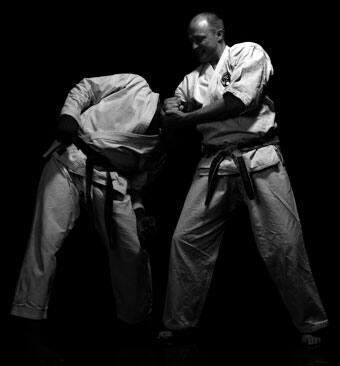
The name Goju is derived from two contrasting terms: Go meaning hard, and Ju meaning soft. Goju differs from most other karate systems in its proximity of fighting. Great emphasis is placed on striking and grappling at close quarters, both standing and on the ground, making it an excellent style for reality-based self-defence.
Heritage
Origins
Goju Ryu traces its roots to the late 19th century, when an Okinawan islander named Kanryo Higaonna travelled to Southern China and trained under a White Crane master named Ryu Ryu Ko. On his return, he taught his art and one of his students began to emerge as exceptional. His name was Chojun Miyagi.
After Higaonna's death in 1915, Miyagi combined his knowledge of Chinese systems with his own native Okinawan fighting arts (Te) to create Goju Ryu Karate. On his death in 1953, Ei'ichi Miyazato took over as the head of the Jundokan and the Okinawan Goju Ryu system.
Key Characteristics
Close-Quarter Combat
Goju Ryu is designed for fighting at close range, including grabs, throws and joint manipulation alongside striking.
Hard & Soft Blend
Closed-fist hard linear attacks combined with open-hand circular deflections create a uniquely versatile system.
Ground & Grappling
Unlike many karate styles, Goju addresses fighting on the ground, reflecting its complete approach to combat.
Okinawan Tradition
Practised in its authentic Okinawan form, not the sport or performance karate that became popular in Japan and the West.
Close-Quarter Combat
The Goju Ryu Way
Quick Facts
- NameGoju Ryu (剛柔流)
- MeaningHard-Soft Style
- OriginOkinawa, Japan
- Founded byChojun Miyagi
- RootsNaha-te + Chinese White Crane
- FocusClose-quarter combat
- At DKKCombat-orientated
Experience it yourself
The best way to understand Goju Ryu is to train it. Monday & Wednesday, 6–8pm, 309 Regent Street, London.
Contact UsThe Ancient Precepts
Eight Poems of the Fist
Taken from the ancient Bubishi text, Chojun Miyagi chose the name Goju-Ryu from the third precept shown below.
- 1
The mind is one with heaven and earth.
- 2
The circulatory rhythm of the body is similar to the cycle of the sun and the moon.
- 3
The way of inhaling and exhaling is hardness and softness.
- 4
Act in accordance with time and change.
- 5
Techniques will occur in the absence of conscious thought.
- 6
The feet must advance and retreat, separate and meet.
- 7
The eyes do not miss even the slightest change.
- 8
The ears listen well in all directions.
Goju is therefore a contrasting term where Go means 'hard' and Ju means 'soft' - the same Ju as used in Ju-do and Ju-jitsu.
Goju Ryu Karate - the hard-soft school of the empty hand.
Symbol of Daigaku Karate Kai
The Badge
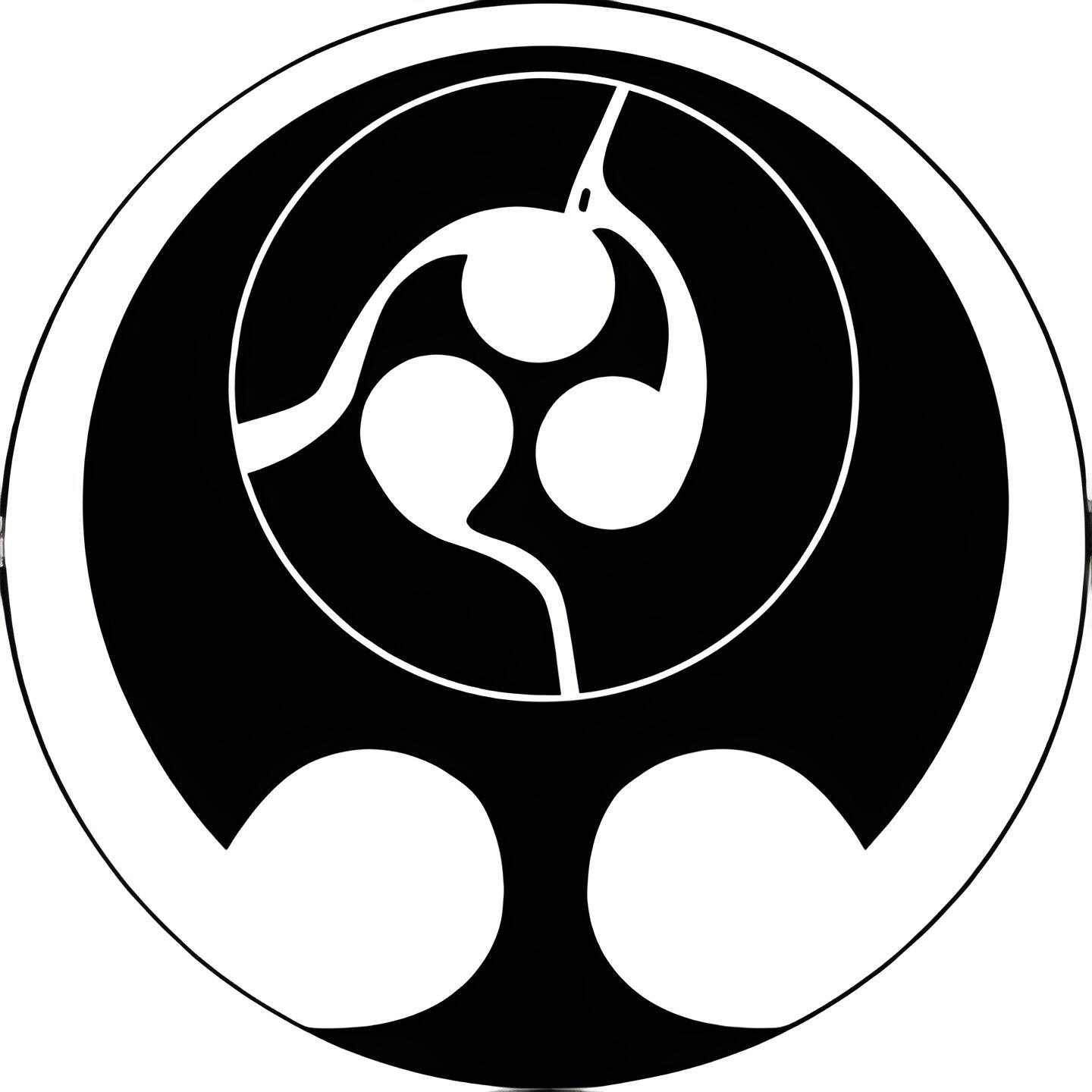
The Badge is the symbol of Daigaku Karate Kai and is a source of honour and pride for those who earn the right to wear it. It cannot be bought. Awarded at Green Belt, it signifies that the association is happy to send the wearer into any dojo in the world.
Outer Ring
Represents the Japanese island of Okinawa, where Karate and Goju Ryu were initially formulated.
Inner Symbol
The emblem of Hachiman, the Japanese God of War, extended to represent the White Crane - the Chinese Kung Fu root of Goju Ryu.
Black & White
Represents hard / soft, yin / yang, and the dual nature of the martial arts.
At Shodan
Black Belts attain the right to have the badge tattooed - permanent recognition of their dedication and inclusion in the brotherhood of DKK.
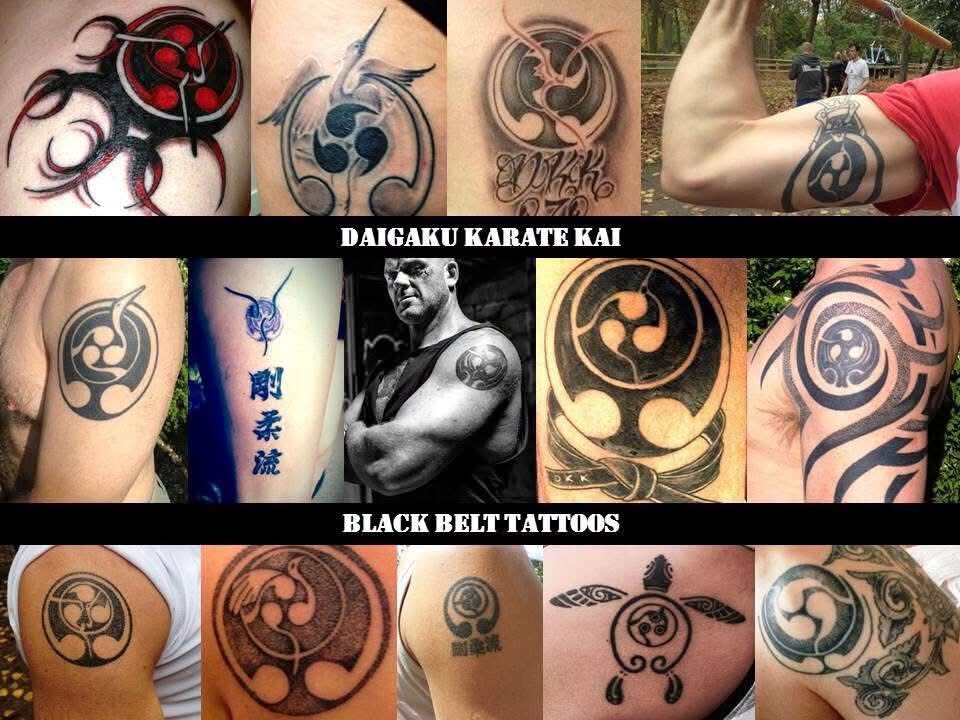
Worn in ink - the DKK badge, tattooed by black belts
Lineage
From Okinawa to London
DKK's line runs through the Jundokan in Okinawa, the early UK Goju pioneers, and a small group of teachers who still shape the way we train today.
Read Our HistoryExperience Goju Ryu for yourself
Monday & Wednesday · 6:00pm - 8:00pm · 309 Regent Street